
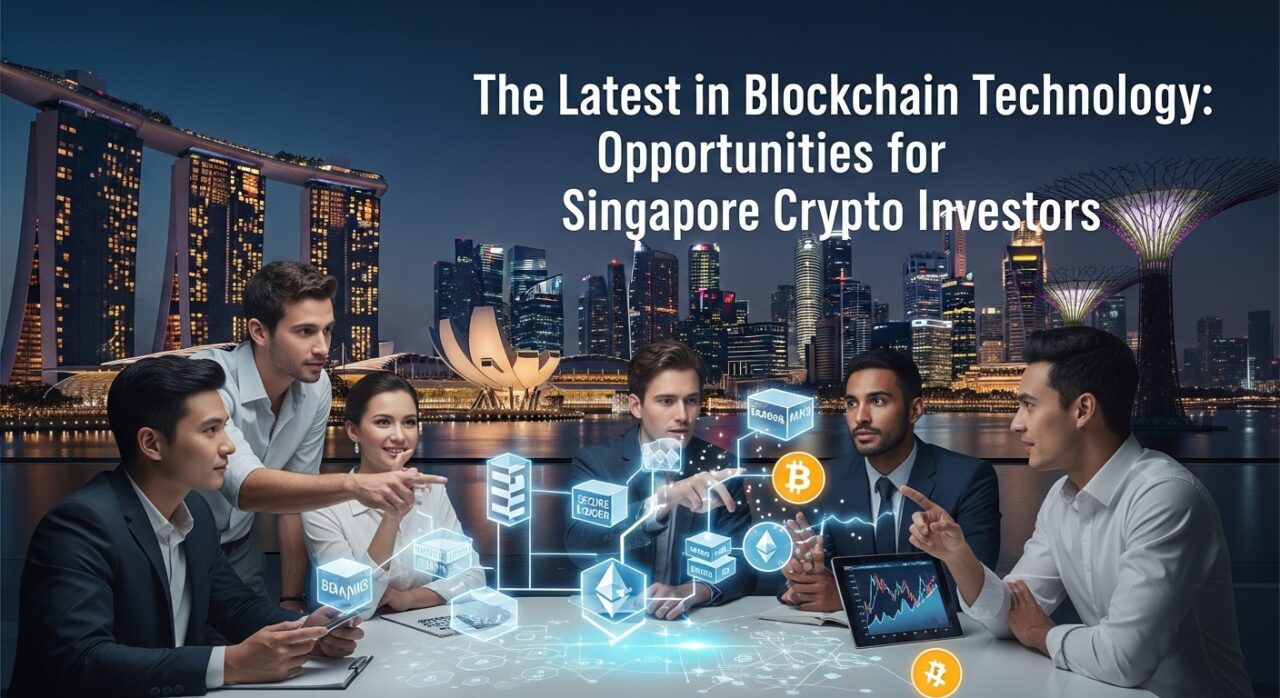
Blockchain has cemented itself as an asset class worth observing in recent years, rising meteorically in price and relevance since its early days. While the crypto scene has seen its fair share of ups and downs, there’s no denying that blockchain technology has made massive strides in innovation and improvement in both the average Singaporean’s personal and professional lives in one way or another.
In 2026, there continues to be a push for new use cases that go beyond speculation with blockchain. Crypto-based systems are also working to promote widespread adoption for a global audience—and rightfully so, as the underlying technology that supports it distinguishes itself from fiat-based systems as it skips the middleman outright.
But that’s not all there is to it. Blockchain technology continues to develop at a rapid pace, and Singaporean crypto investors can score in on this advancement by striking when the iron is hot. And that starts with spotting opportunities and making the right decision within that timeframe.
So without further ado, here are four trends in the crypto world that Singaporean crypto investors should be aware of in 2026. Let’s jump right into it!
-
Increased Tokenisation of Assets
One blockchain development that Singaporean investors can expect is an exponential rise in asset tokenisation, particularly property tokenisation.
Real estate is among the most expensive asset classes for most people, and it’s not unheard of for many eager investors to be priced out of most real estate properties available in the property market.
However, in the past few years, the tokenisation of real-world assets such as properties has exploded in popularity. It’s even been claimed that tokenisation of real estate properties has grown by 308% in the past three years, highlighting a sustained interest for both buyers and sellers to score in on this scheme.
The reason why real-world asset tokenisation is surging within the space is simple: it lowers cost barriers and paves the way for a larger number of participants to partake in fractional ownership of specific asset classes without needing to spend as much money as they normally would.
For Singaporean crypto investors, this is an ideal set-up. The income-generating potential of real estate tokenisation helps crypto traders increase their yields without spending too much money.
Plus, most residential properties in Singapore are held on a 99-year leasehold, after which ownership reverts to the government. The tokenisation scheme bypasses this law in the sense that you have complete ownership of the digital representation of the property.
It also all aligns with the frameworks set by the Monetary Authority of Singapore, or the local finance regulating authority. So you have no worries about getting in trouble with the law when investing in this potent asset class.
-
Higher Rates of Institutional Adoption
Another development of blockchain technology is its rapid institutionalisation across the finance and payments industries all around the world, particularly in the US.
Not too long ago, crypto was seen with scrutiny by corporations and financial entities. It wasn’t taken seriously, even as more retail investors jump in on the trend.
However, there’s a shift in its perception as the price of prominent cryptocurrencies like Bitcoin and Ethereum have shot up in a small timeframe. Now, fintech firms and banks are taking a more active role in incorporating crypto and blockchain technology in their operations.
In fact, some of these digital assets are even being included in ETFs backed by these institutions themselves—and such assets are considered completely legitimate to buy, hold, and sell. This has created an environment where blockchain projects and crypto are seen as legitimate, improving consumer sentiment and signalling optimism in the market.
Singaporean crypto investors can jump in on the increased consumer optimism and explore crypto and digital assets via Independent Reserve Singapore. That way, they can capitalise on this new and high-ceiling asset class early on.
-
Expanding Regulations Regarding Crypto Licensing
Another trend on blockchain technology that Singaporean investors should keep in mind is the maturing regulations surrounding digital assets and blockchain technology. This is applicable to both crypto holders and businesses dealing with the digital token in one way or another.
One recent development is that, as of June of last year, the Financial Services and Markets Act (FSMA) made it a requirement for Singaporean corporate entities to hold a Digital Token Service Provider (DTSP) license if they plan to accept crypto payments from citizens or clients outside the country.
This is one of the country’s latest steps to furthering its standards on upholding market integrity.
Moreover, MAS has also tightened its threshold for approvals on licenses for businesses planning to incorporate digital token services to clients outside the country. This move is done to regulate offshore activity and limit illegal activities from taking place.
The tightened grip on regulations for crypto-based services in Singapore shows one thing: Singaporean policymakers are firm on their stance of regulating crypto and preventing it from spiralling out of control.
While cryptocurrency isn’t a completely risk-free space, government entities can nip potential problem areas by the root and prevent unscrupulous individuals from taking advantage of unsuspecting investors or undetected loopholes.
-
AI and Blockchain Convergence
While blockchain technology entered public awareness earlier than AI, these two periods of technology intersect and play off one another in a complementary fashion.
This is promising for the Singaporean landscape, as this ASEAN hub is a powerhouse when it comes to both fintech adoption and AI-led innovation—both from a business perspective and an investor perspective.
On the blockchain side, the underlying technology can help improve AI verification processes as it can validate digital ownership of AI-generated content. This helps internal teams and auditors verify output and reduce the chance of misinformation from getting spread.
For AI, this technology can help strengthen the blockchain ecosystem by scaling dataset volume classification and providing executives with better decision-making perspectives on matters that can help their crypto business grow.
In any case, these two technologies can be appealing for Singaporean crypto investors because they help reduce risks and improve decision-making that neither of them can do alone. On top of that, innovations on both fronts are also rapidly being discovered in 2026, and it doesn’t look like it’s stopping anytime soon.
We hope that we’ve given enough insights into the benefits of blockchain technology for Singaporean investors. All the best in riding high in your crypto journey!