
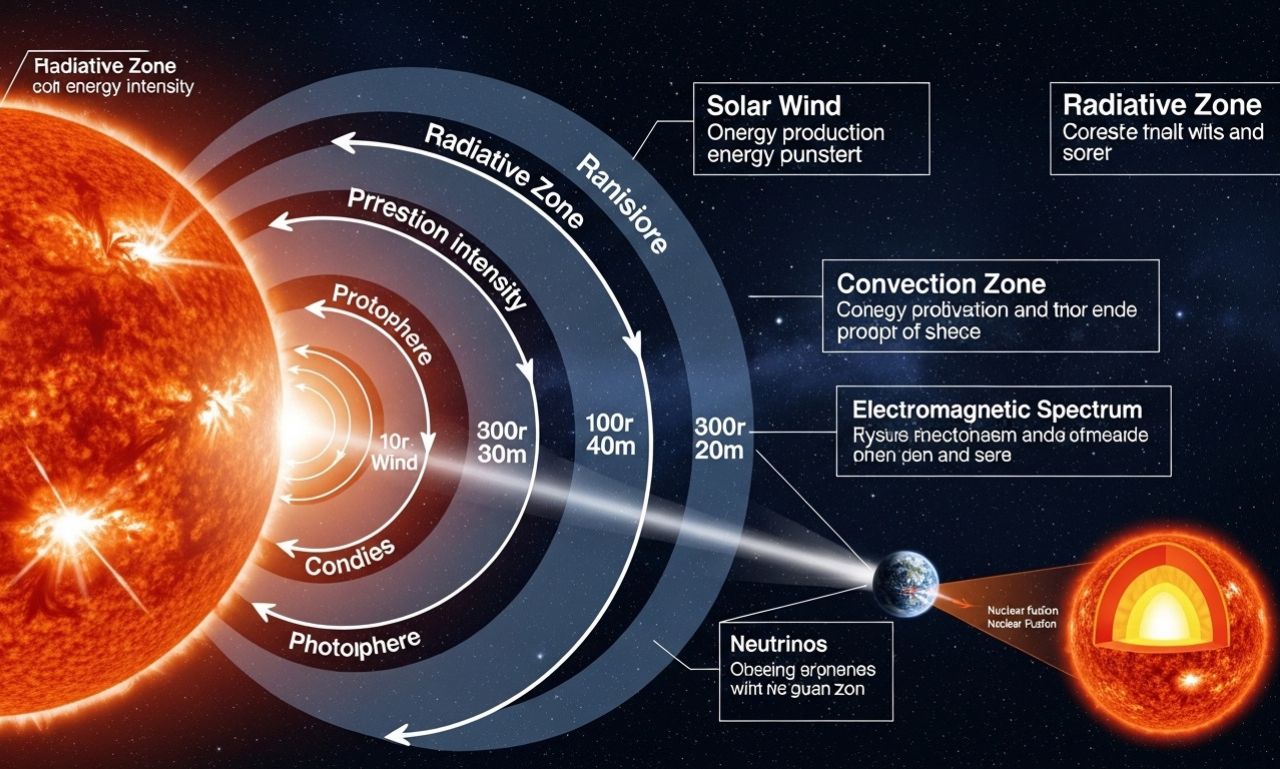
Sun luminosity is a fundamental concept in astronomy and astrophysics that refers to the total amount of energy emitted by the Sun per unit of time. It is one of the key parameters used to understand the Sun’s behavior, its effect on the solar system, and the energy that sustains life on Earth.
This article explores what sun luminosity is, how it is measured, its importance, and its broader implications in science and everyday life.
What is Sun Luminosity?
Sun luminosity is the total energy radiated by the Sun in all directions per second. It is usually measured in watts (W) and is considered a standard unit of stellar energy output. The Sun’s luminosity is approximately:
L☉ ≈ 3.828 × 10²⁶ watts
Where L☉ represents the solar luminosity, a unit often used to compare other stars’ brightness.
Luminosity is different from brightness or apparent magnitude, which describe how bright a star appears from Earth. Luminosity measures intrinsic energy output, independent of distance.
How is Sun Luminosity Measured?
Astronomers measure the Sun’s luminosity using a combination of observational data and physical principles:
-
Solar Constant Measurement – The amount of solar energy received per square meter at Earth’s distance (1 AU).
-
Distance Scaling – Using the inverse-square law, scientists calculate total energy output from the Sun.
-
Spectral Analysis – Measuring radiation across all wavelengths, including visible light, infrared, and ultraviolet.
The precise value of the Sun’s luminosity allows scientists to model stellar evolution and predict energy input to Earth.
Importance of Sun Luminosity
Sun luminosity is crucial for several reasons:
1. Sustaining Life on Earth
The Sun’s energy drives photosynthesis in plants, powers the climate system, and maintains temperatures suitable for life. Without this energy, Earth would be an uninhabitable frozen planet.
2. Understanding Stellar Physics
Luminosity helps astronomers classify stars, estimate their size, mass, and age, and understand nuclear fusion processes in stellar cores.
3. Solar Energy Research
Knowing the Sun’s luminosity is essential for designing solar panels, calculating energy potential, and planning renewable energy projects.
4. Climate and Weather Models
The Sun’s energy output affects Earth’s climate patterns, atmospheric circulation, and long-term climate changes. Accurate luminosity data helps improve climate predictions.
Factors Affecting Sun Luminosity
The Sun’s luminosity is relatively stable but can vary slightly due to:
-
Solar cycles – Approximately every 11 years, the Sun’s magnetic activity fluctuates, affecting solar radiation.
-
Sunspots – Darker, cooler areas on the Sun can temporarily reduce luminosity.
-
Flares and coronal mass ejections – Sudden bursts of energy slightly increase luminosity over short periods.
These variations are minor and do not significantly affect Earth’s overall energy input.
Sun Luminosity in Astronomy
Astronomers use solar luminosity as a benchmark for comparing other stars. For example:
-
A star with 2 L☉ is twice as luminous as the Sun.
-
A star with 0.1 L☉ is only one-tenth as luminous.
This helps classify stars into categories such as dwarfs, giants, or supergiants and aids in understanding stellar evolution.
Conclusion
Sun luminosity is a measure of the Sun’s total energy output and is vital for life on Earth, climate modeling, and astronomy. Understanding this concept helps scientists study not only our star but also other stars in the universe.
The Sun’s constant energy output, approximately 3.828 × 10²⁶ watts, ensures that life thrives on Earth and allows astronomers to explore the mysteries of stellar physics with accuracy.