
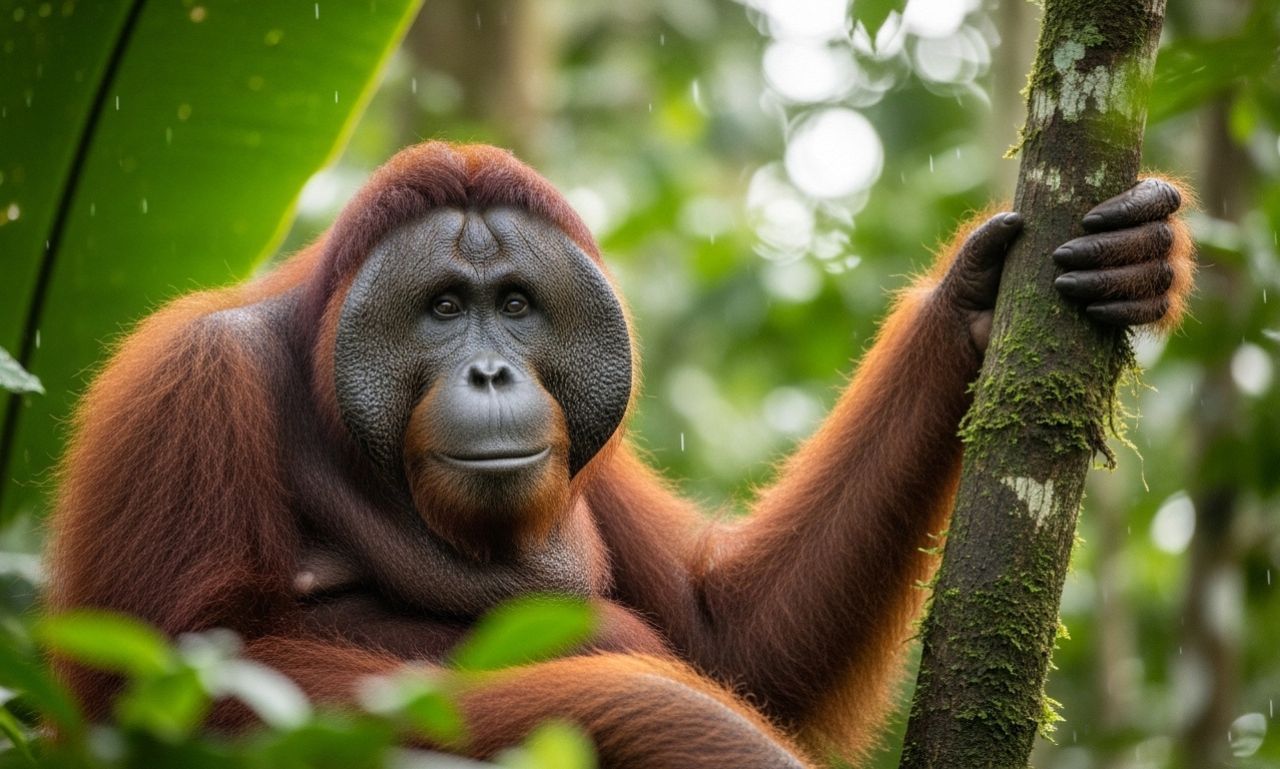
The orangutan is one of the most intelligent and fascinating primates in the world. Known for its long reddish hair and thoughtful expression, the orangutan is a great ape that lives in the tropical rainforests of Southeast Asia. The name “orangutan” comes from the Malay words “orang” (person) and “hutan” (forest), meaning “person of the forest.”
Orangutans are among humans’ closest relatives, sharing about 97% of their DNA with humans. These highly intelligent animals are famous for their problem-solving abilities, use of tools, and strong bonds between mothers and their young.
Physical Characteristics
Orangutans have a distinctive appearance that sets them apart from other great apes.
Key physical features include:
-
Long, reddish-brown fur
-
Very long arms, sometimes reaching over 2 meters (6.5 feet) from fingertip to fingertip
-
Strong hands and feet for gripping tree branches
-
Large body size
Male vs Female Differences
Adult male orangutans develop unique traits as they mature:
-
Large cheek pads called flanges
-
A throat pouch used to make loud calls
-
Larger body size than females
Males can weigh up to 100 kg (220 pounds), while females are generally smaller.
Habitat and Distribution
Orangutans are native to the rainforests of Indonesia and Malaysia.
They are found on only two islands:
-
Borneo
-
Sumatra
These dense tropical forests provide everything orangutans need, including food, shelter, and tall trees for climbing and building nests.
Unlike many other primates, orangutans spend most of their lives in trees, making them one of the largest arboreal mammals in the world.
Diet and Feeding Habits
Orangutans are primarily frugivores, meaning they mostly eat fruit.
Their diet includes:
-
Fruits such as figs and durian
-
Leaves
-
Bark
-
Flowers
-
Seeds
-
Insects
During times when fruit is scarce, orangutans can adapt by eating tougher foods like bark and roots.
Their strong jaws allow them to crack open hard fruits that many other animals cannot eat.
Intelligence and Tool Use of Orangutan
Orangutans are among the most intelligent animals on Earth.
Scientists have observed them using tools such as:
-
Sticks to extract insects or honey
-
Leaves as gloves to handle spiky fruits
-
Branches as umbrellas during rain
They also build sleeping nests in trees every night using branches and leaves.
Research shows orangutans can:
-
Solve complex problems
-
Learn from observation
-
Demonstrate memory and planning skills
Social Behavior of Orangutan
Unlike chimpanzees or gorillas, orangutans are mostly solitary animals.
Typical social behavior includes:
-
Adult males living alone
-
Females staying with their young
-
Occasional interactions at feeding sites
The bond between mother and baby orangutan is extremely strong. Young orangutans stay with their mothers for 6–8 years, one of the longest childhoods in the animal kingdom.
Reproduction and Life Cycle
Orangutans reproduce more slowly than almost any other mammal.
Reproductive facts:
-
Gestation period: about 8.5 months
-
Usually one baby at a time
-
Mothers give birth only every 7–9 years
This slow reproduction rate makes it difficult for populations to recover when numbers decline.
Orangutans can live 40–50 years in the wild, and sometimes longer in captivity.
Conservation Status of Orangutan
Orangutans are considered Critically Endangered, meaning they face a very high risk of extinction in the wild.
Major threats include:
-
Deforestation
-
Palm oil plantation expansion
-
Illegal hunting
-
Wildlife trafficking
-
Forest fires
Large areas of rainforest have been destroyed, reducing the natural habitat available for orangutans.
Importance to the Ecosystem
Orangutans are known as “forest gardeners.”
By eating fruit and spreading seeds throughout the forest, they help:
-
Maintain forest biodiversity
-
Support plant regeneration
-
Keep rainforest ecosystems healthy
Without orangutans, many plant species could struggle to reproduce.
Conclusion on Orangutan
Orangutans are remarkable great apes known for their intelligence, gentle nature, and strong connection to forest ecosystems. Living high in the trees of Southeast Asia’s rainforests, they play a crucial role in maintaining biodiversity. However, habitat destruction and human activities have placed these incredible animals in danger. Protecting orangutans and their forest homes is essential to ensure their survival for future generations.