
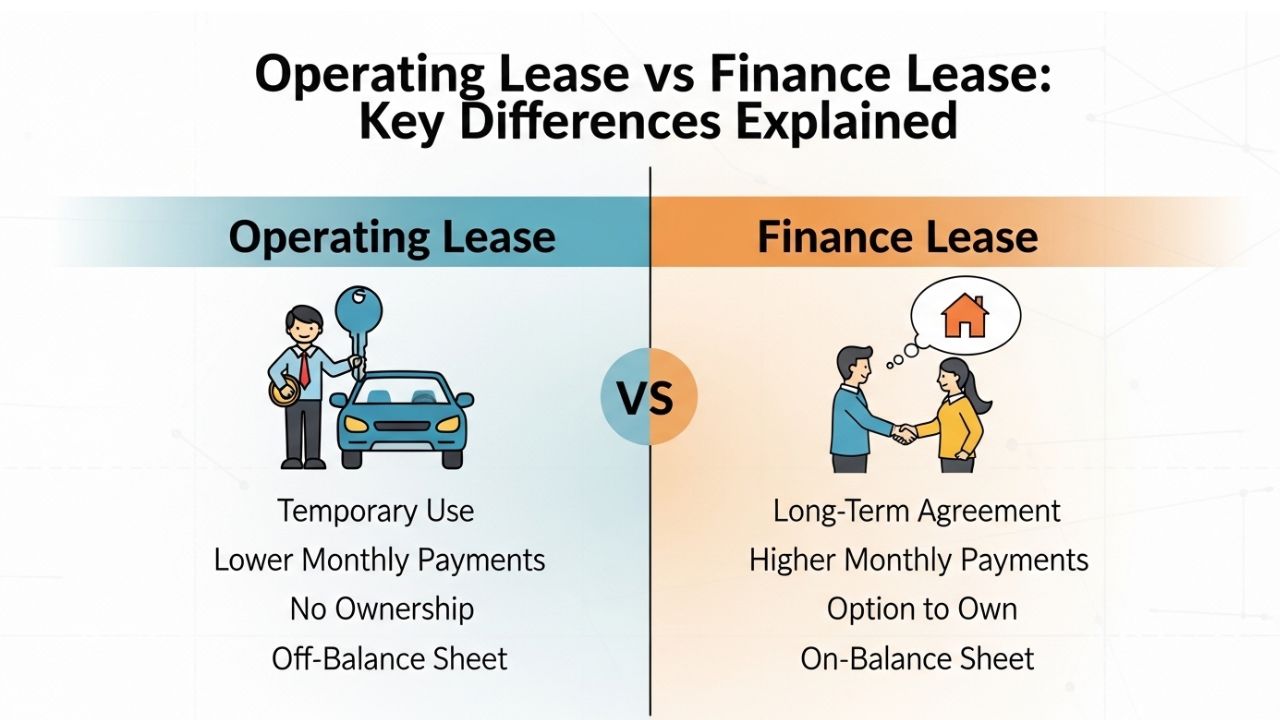
In business and accounting, understanding the difference between an operating lease vs finance lease is crucial for making smart financial decisions. Both are types of leasing agreements that allow companies to use assets without purchasing them outright, but they differ in ownership, accounting treatment, risk, and financial impact. This article breaks down the two types of leases, their features, advantages, disadvantages, and how they are recorded in financial statements.
What Is an Operating Lease?
An operating lease is a rental agreement in which the lessee (the user of the asset) pays for the right to use an asset for a specific period, but the ownership of the asset remains with the lessor.
Key Features of an Operating Lease:
- Short-term or medium-term rental agreements
- Ownership stays with the lessor
- Asset is usually returned at the end of the lease term
- Lessee pays periodic lease rentals
- Maintenance and insurance may be the responsibility of the lessor in some agreements
Example:
A company rents office space or copies of equipment for three years under an operating lease. At the end of the term, the equipment is returned to the lessor.
Accounting Treatment:
- Lease payments are treated as operating expenses in the income statement.
- The leased asset does not appear on the balance sheet for older accounting standards, though IFRS 16 and ASC 842 require most leases to be capitalized on the balance sheet.
What Is a Finance Lease?
A finance lease (also called a capital lease) is a lease agreement where the lessee assumes substantially all risks and rewards of ownership of the asset, even though legal ownership may transfer later or not at all.
Key Features of a Finance Lease:
- Long-term lease, usually covering most of the asset’s useful life
- Lessee is responsible for maintenance and insurance
- Ownership may transfer at the end of the lease term (bargain purchase option)
- Lease payments include both principal and interest components
Example:
A company leases machinery for five years, which covers most of its useful life, and has an option to purchase the machinery at a nominal price at the end of the lease.
Accounting Treatment:
- The asset and corresponding lease liability are recognized on the balance sheet.
- Depreciation is recorded on the leased asset, and interest expense is recognized on the lease liability.
- Classified as a capital expenditure rather than a simple operating expense.
Key Differences Between Operating Lease and Finance Lease
| Feature | Operating Lease | Finance Lease |
|---|---|---|
| Ownership | Remains with lessor | Lessee bears most ownership risks |
| Lease Term | Usually short-term | Usually long-term covering most of asset life |
| Balance Sheet Impact | Traditionally off-balance sheet (except IFRS 16/ASC 842) | On balance sheet as asset & liability |
| Risk & Reward | Lessor bears risks (maintenance, obsolescence) | Lessee bears risks & rewards |
| End of Lease | Asset is returned to lessor | Option to purchase, asset may stay with lessee |
| Accounting Treatment | Lease rentals recorded as expense | Depreciation + interest expense |
| Financial Ratios Impact | Less impact on debt ratios | Increases liabilities and assets |
Advantages of Operating Leases
- Lower upfront costs compared to buying the asset
- Flexibility to upgrade or return assets after lease term
- May reduce maintenance responsibilities
- Can improve financial ratios by keeping lease off balance sheet (under older standards)
Advantages of Finance Leases
- Lessee gains economic benefits of ownership
- Predictable long-term asset use
- Option to own asset at the end of lease term
- Useful for capital-intensive assets without upfront purchase
Choosing Between Operating Lease vs Finance Lease
Businesses should consider several factors before deciding:
- Duration of Use: Short-term use favors operating leases; long-term, high-utilization assets favor finance leases.
- Balance Sheet Impact: Finance leases increase assets and liabilities; operating leases may minimize balance sheet impact.
- Tax Considerations: Lease payments for operating leases are often fully deductible as expenses. Finance leases allow depreciation and interest deduction.
- Flexibility: Operating leases are better for technology or equipment that becomes obsolete quickly.
- Ownership Desire: Finance leases are suitable if the company intends to eventually own the asset.
Accounting Standards Update
With IFRS 16 (effective 2019) and ASC 842, most leases, including operating leases, must be recognized on the balance sheet, reducing the off-balance-sheet advantage. However, the underlying differences in risk, ownership, and expense treatment between operating and finance leases remain important.
Conclusion
Understanding operating lease vs finance lease is essential for corporate finance, accounting, and business decision-making. While operating leases offer flexibility and lower short-term costs, finance leases provide long-term ownership benefits and control over assets. Companies must evaluate the asset type, lease term, financial ratios, tax impact, and strategic goals to choose the appropriate lease type. Proper classification also ensures accurate reporting, transparency, and compliance with modern accounting standards.