
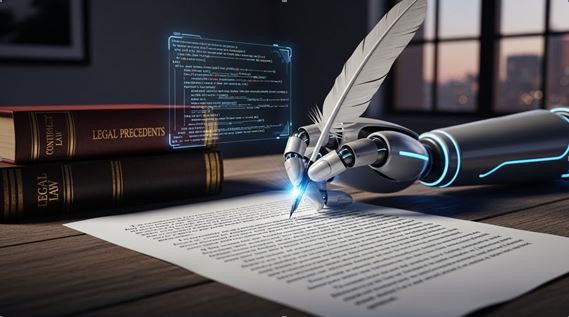
Legal drafting sits at the heart of the legal profession. Contracts, pleadings, policies, and opinions must be precise, unambiguous, and legally sound—where even a single misplaced word can change rights and obligations. With recent advances in artificial intelligence, a critical question has emerged across law firms and corporate legal teams: can AI legal drafting tools actually write legal documents?
This article explores how ai legal drafting works, what it can and cannot do, where it delivers real value, its risks and limitations, and how lawyers should use it responsibly in modern legal practice.
What Is AI Legal Drafting?
AI legal drafting refers to the use of artificial intelligence—primarily natural language processing (NLP) and large language models—to generate, revise, and optimize legal documents.
These tools are trained on vast datasets of legal texts, including contracts, statutes, case law, and templates. Instead of writing documents line by line from scratch, ai legal drafting systems generate structured drafts based on prompts, templates, and contextual inputs.
Importantly, AI does not “understand” the law in a human sense—it predicts language patterns that resemble legally valid text. This distinction is critical when assessing its role and limitations.
Why Legal Drafting Is Ripe for AI Assistance
Legal drafting is repetitive, time-intensive, and template-driven in many areas. Lawyers often:
- Reuse standard clauses and agreements
- Adapt existing documents to new transactions
- Draft similar contracts across clients
- Spend hours formatting and refining language
These characteristics make drafting an ideal candidate for ai legal assistance—particularly for first drafts and standard documents.
How AI Legal Drafting Works
Natural Language Processing (NLP)
NLP enables ai legal tools to understand prompts written in plain English, such as:
“Draft a non-disclosure agreement for a software services company in India.”
The system analyzes the request and generates a structured document aligned with typical legal formats.
Template and Pattern Learning
AI drafting tools learn from thousands of legal templates and examples. They recognize patterns such as:
- Clause structure
- Legal phrasing
- Common definitions
- Standard risk allocations
This allows them to produce documents that “look” legally correct.
Contextual Adaptation
More advanced ai legal drafting tools can adapt language based on:
- Jurisdiction
- Industry
- Contract type
- Risk preferences
However, this adaptation still requires careful human review.
What AI Legal Drafting Can Do Well
- Generate First Drafts Quickly
One of the strongest use cases for ai legal drafting is creating initial drafts. Tasks that once took hours can now be completed in minutes.
This is especially useful for:
- NDAs
- Employment contracts
- Service agreements
- Privacy policies
- Internal policies
- Standardize Legal Language
AI legal tools help ensure consistency across documents by reusing approved clauses and terminology.
This reduces:
- Inconsistent drafting
- Missing provisions
- Conflicting language
- Edit, Rewrite, and Simplify Text
AI drafting tools can:
- Rewrite clauses for clarity
- Simplify complex legal language
- Align tone across documents
- Remove redundancy
This improves readability and professionalism.
- Assist with Localization
Some ai legal tools adapt documents for different jurisdictions by adjusting terminology and structural elements—though this is not a substitute for local legal expertise.
What AI Legal Drafting Cannot Do Reliably
Legal Judgment and Risk Assessment
AI cannot evaluate:
- Commercial intent
- Negotiation strategy
- Risk tolerance
- Business objectives
Only human lawyers can balance legal, commercial, and ethical considerations.
Handle Novel or Complex Transactions
Highly customized agreements—such as complex M&A contracts or bespoke regulatory filings—require deep legal reasoning beyond current ai legal capabilities.
Guarantee Legal Accuracy
AI-generated text may sound correct but still:
- Miss mandatory clauses
- Include outdated legal concepts
- Misapply jurisdiction-specific rules
This makes human review non-negotiable.
Risks of Using AI Legal Drafting Without Oversight
Hallucinations and Errors
AI systems may generate clauses that:
- Reference non-existent laws
- Misstate legal principles
- Use incorrect terminology
These errors can be subtle and dangerous.
Confidentiality and Data Security
Uploading sensitive client data into ai legal drafting tools without proper safeguards can expose confidential information.
Unauthorized Practice of Law
If used improperly—especially by non-lawyers—AI drafting tools may raise concerns about unauthorized legal practice.
Best Practices for Using AI Legal Drafting Tools
To use ai legal drafting safely and effectively, lawyers should:
- Treat AI output as a draft, not a final document
- Always conduct thorough legal review
- Use firm-approved templates and playbooks
- Avoid entering sensitive client data into unsecured tools
- Clearly disclose AI-assisted drafting where appropriate
AI should assist—not replace—professional responsibility.
AI Legal Drafting vs Traditional Drafting
| Aspect | Traditional Drafting | AI Legal Drafting |
| Speed | Slow | Very fast |
| Consistency | Lawyer-dependent | High |
| Creativity & Strategy | High | Limited |
| Risk Evaluation | Human | Human only |
| Final Responsibility | Human | Human |
This comparison reinforces the assistive, not autonomous, role of AI.
Impact on Lawyers and Legal Training
Rather than reducing the need for lawyers, ai legal drafting is changing how lawyers work.
Junior lawyers:
- Spend less time on formatting
- Focus more on learning strategy and analysis
Senior lawyers:
- Review faster
- Provide higher-value input
Legal education will increasingly emphasize reviewing, supervising, and improving AI-generated work.
The Future of AI Legal Drafting
Future advancements may include:
- Firm-specific drafting assistants
- Real-time clause risk scoring
- Negotiation-aware drafting suggestions
- Integration with contract lifecycle systems
Despite these advances, human judgment will remain central.
Can AI Fully Replace Legal Drafting?
The short answer is no.
AI can write text—but it cannot:
- Understand intent
- Assume legal responsibility
- Exercise ethical judgment
- Advocate for a client
The future of drafting is human-led and AI-assisted.
Conclusion
AI legal drafting is a powerful productivity tool that is transforming how legal documents are created. It accelerates drafting, improves consistency, and reduces manual effort—but it does not replace legal expertise.
When used responsibly, ai legal drafting allows lawyers to focus less on mechanics and more on strategy, judgment, and client value. The key is not asking whether AI can write legal documents—but understanding how lawyers should work with AI to write better ones.