
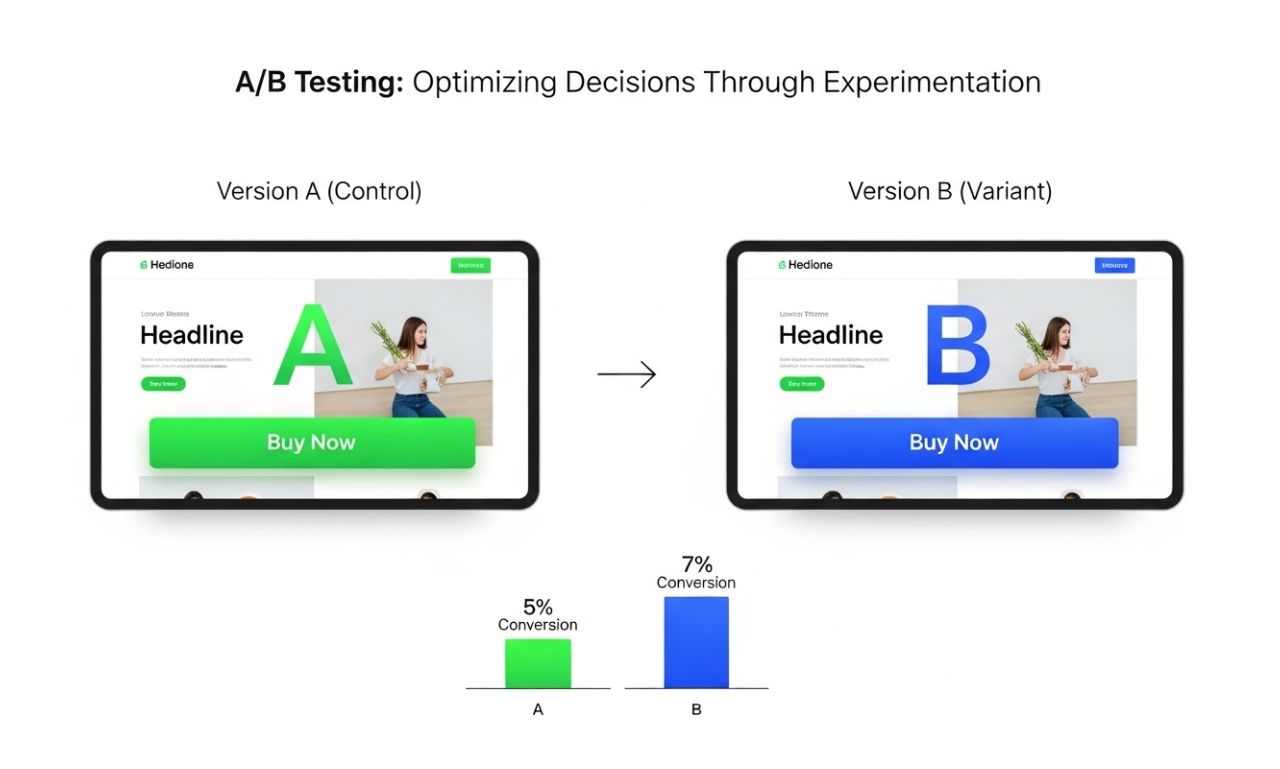
A/B testing is a powerful method used in marketing, product development, and web optimization to compare two versions of a webpage, app feature, email, or advertisement to determine which performs better. By analyzing user behavior and conversion rates, businesses can make data-driven decisions that improve engagement, sales, and overall user experience.
This article explores the concept of A/B testing, its process, benefits, challenges, and best practices for implementing effective experiments.
What is A/B Testing?
A/B testing, also known as split testing, involves presenting two variants—A (control) and B (variation)—to users simultaneously. The goal is to determine which version achieves a specific objective, such as higher click-through rates, conversions, or engagement.
Key components of A/B testing include:
-
Hypothesis – A clear prediction about how a change will impact user behavior.
-
Control Version (A) – The original version of a webpage, email, or feature.
-
Variation Version (B) – The modified version designed to test improvements.
-
Metrics – Quantitative measures such as clicks, conversions, or time spent.
A/B testing allows teams to make decisions based on empirical data rather than assumptions or intuition.
The A/B Testing Process
Successful A/B testing follows a structured process:
1. Identify the Goal
Before testing, define a clear objective. For example, increasing newsletter sign-ups, boosting e-commerce sales, or improving app engagement.
2. Create Variations
Develop a variation that targets the identified goal. This could involve changing headlines, call-to-action buttons, images, layouts, or colors.
3. Segment Your Audience
Randomly divide users into two groups to ensure unbiased results. One group sees the control version (A), while the other sees the variation (B).
4. Run the Test
Collect data over a defined period to capture statistically significant results. The duration depends on traffic volume and the desired confidence level.
5. Analyze Results
Compare performance metrics to determine which version outperforms the other. Statistical significance ensures that observed differences are unlikely due to chance.
6. Implement Changes
Once a winner is identified, implement the change across all users to maximize the benefits.
Applications of A/B Testing
A/B testing is widely used across industries to optimize digital experiences:
Web Design and Conversion Rate Optimization
Companies test website layouts, navigation menus, product pages, and call-to-action buttons to increase user engagement and conversions.
Email Marketing
Marketers test subject lines, email copy, images, and send times to improve open and click-through rates.
Mobile Apps
App developers use A/B testing to optimize onboarding experiences, in-app features, and notifications to enhance retention and user satisfaction.
Advertising Campaigns
Digital advertisers test different ad creatives, headlines, and target segments to improve return on ad spend (ROAS) and campaign performance.
Benefits of A/B Testing
A/B test ing offers several advantages for businesses and organizations:
-
Data-Driven Decisions – Reduces guesswork and improves decision-making.
-
Improved User Experience – Identifies changes that enhance usability and satisfaction.
-
Increased Conversions – Optimizes elements that drive sales, sign-ups, or other goals.
-
Risk Mitigation – Tests changes on a smaller scale before full implementation.
-
Continuous Improvement – Encourages a culture of experimentation and optimization.
Challenges of A/B Testing
While powerful, A/B test ing has limitations and challenges:
-
Sample Size and Traffic – Low traffic can make results statistically insignificant.
-
Time Constraints – Tests require sufficient time to collect meaningful data.
-
Multiple Variables – Testing too many changes simultaneously can obscure results.
-
Misinterpretation of Data – Incorrect analysis may lead to misleading conclusions.
-
User Behavior Changes – External factors or seasonal trends can impact results.
Proper planning and analysis are essential to avoid these pitfalls.
Best Practices for A/B Testing
To ensure effective and reliable testing, follow these best practices:
-
Start with a Clear Hypothesis – Know what you are testing and why.
-
Test One Variable at a Time – Avoid confounding results by changing multiple elements simultaneously.
-
Use Statistical Significance – Ensure results are meaningful before implementing changes.
-
Segment Users Carefully – Randomize groups to prevent bias.
-
Iterate Continuously – Test, analyze, implement, and repeat to improve outcomes consistently.
-
Document Results – Keep records of all tests, outcomes, and learnings for future reference.
Tools for A/B Testing
Several tools help businesses implement A/B testi ng efficiently:
-
Optimizely – Offers A/B and multivariate testing for web and apps.
-
Google Optimize – Free tool for website experiments and personalization.
-
VWO (Visual Website Optimizer) – Provides testing, heatmaps, and conversion tracking.
-
Adobe Target – Enterprise-level testing and personalization solutions.
-
Mailchimp & HubSpot – Email marketing platforms with built-in A/B testing features.
These tools simplify experiment setup, tracking, and analysis.
Future of A/B Testing
The future of A/B testi ng is being shaped by:
-
AI and Machine Learning – Automated testing and personalization based on user behavior.
-
Multivariate and Adaptive Testing – Testing multiple elements simultaneously and dynamically adapting for different segments.
-
Integration with Analytics – Real-time insights to optimize campaigns faster and more efficiently.
-
Cross-Platform Testing – Evaluating user experiences across web, mobile, and app interfaces simultaneously.
As businesses increasingly prioritize personalization, A/B test ing remains a cornerstone of effective digital strategy.
Conclusion
A/B te sting is a critical tool for modern marketers, developers, and product teams. By comparing variations of webpages, emails, apps, and advertisements, organizations can make informed, data-driven decisions that improve user engagement and business outcomes. Following best practices and leveraging modern testing tools ensures reliable results, helping companies continually optimize their digital presence.