
Last updated: August 23, 2026
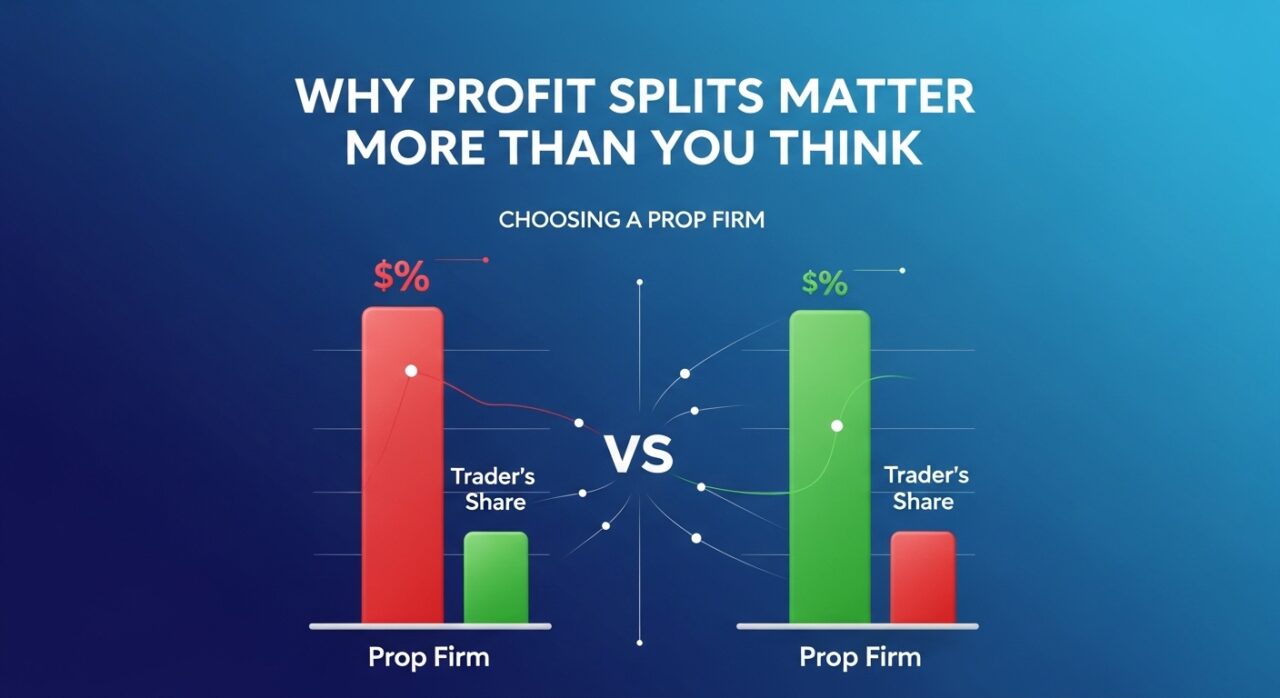
Our Experience: When comparing prop firms, most traders look at profit splits first. An 80 percent split versus 90 percent seems like a straightforward decision. But the prop firm profit split is far more nuanced than the headline number suggests, and understanding those nuances can mean the difference between a firm that actually pays well and one that just markets well.
The Headline Number Is Not the Full Story
A firm advertising a 100 percent profit split prop firm sounds unbeatable on paper. But that number means nothing without context. What are the conditions required to reach that split? Is it available from day one or only after multiple successful payout cycles? Does the firm compensate for the generous split with tighter drawdown limits, higher challenge fees, or slower payout processing?
These are the questions most beginners skip, and they pay for it later. A profit split comparison that only looks at percentages without evaluating the surrounding conditions is fundamentally incomplete. A trader keeping 80 percent of profits with reliable on-demand payouts, fair drawdown rules, and swap-free conditions may end up with more money in their pocket than a trader chasing 100 percent at a firm with hidden restrictions and delayed withdrawals.
How Profit Splits Actually Work in Practice
Most prop firms structure their splits in tiers. You might start at 80 percent and scale to 90 or even 100 percent based on consistency, total profit generated, or number of successful payout cycles completed. This tiered approach rewards long-term performance rather than one-time results.
Some firms offer the best profit share on their one-step evaluation programs, where the higher challenge fee justifies a more generous split from the start. Others reserve top-tier splits for instant funding accounts where the upfront cost is significantly higher. Two-step programs, being the most affordable entry point, typically start at a slightly lower split but offer scaling opportunities over time.
Understanding which program type offers which split, and what conditions must be met to unlock higher tiers, is essential before committing to any firm.
The Hidden Factors That Eat Into Your Split
A high profit split loses its value quickly if other costs are working against you. There are several factors that effectively reduce your real take-home earnings regardless of what the advertised split says.
Spreads and commissions directly impact profitability on every trade. A firm offering 90 percent profit split but charging wide spreads and high commissions per lot is quietly taking back a portion of that generous headline number through trading costs. Firms with tight spreads and transparent commission structures protect your actual earnings.
Payout fees and minimum withdrawal amounts create another hidden reduction. If a firm charges processing fees on every withdrawal or requires a minimum balance before you can cash out, your effective split drops below the advertised rate.
Swap charges on overnight positions add up significantly for swing traders. Firms that offer swap-free accounts across all program types eliminate this cost entirely, preserving more of your profit for the actual split calculation.
What a Meaningful Profit Split Comparison Looks Like
Rather than comparing headline percentages, evaluate the complete cost structure. The firm with the best effective split is the one where trading costs are low, payouts are fast and free, rules are clear, and the path to higher split tiers is realistic and well-documented.
The best prop trading firms make this comparison easy by publishing their full fee structures, split tiers, and scaling requirements transparently. They do not hide behind asterisks or bury conditions in terms of service that only become visible after you have already paid for a challenge.
Look for firms that combine competitive starting splits with genuine scaling potential, low trading costs, and payout reliability. A firm paying 80 percent consistently and quickly is more valuable than a firm promising 100 percent that takes weeks to process or finds reasons to deny withdrawals.
Making the Right Choice
Profit splits matter, but they matter as part of a bigger picture. The traders who earn the most from prop trading are not necessarily the ones with the highest split percentage. They are the ones who chose firms where the complete package, split, conditions, costs, and payout reliability, works in their favor.
One firm that balances these factors effectively is funded trader markets. With profit splits up to 100 percent on evaluation programs, 80 percent on instant funding accounts, swap-free conditions across all plans, and on-demand payouts guaranteed within 24 hours, they offer a structure where the advertised split closely matches what traders actually take home.