
Last updated: August 23, 2026
Our Experience:
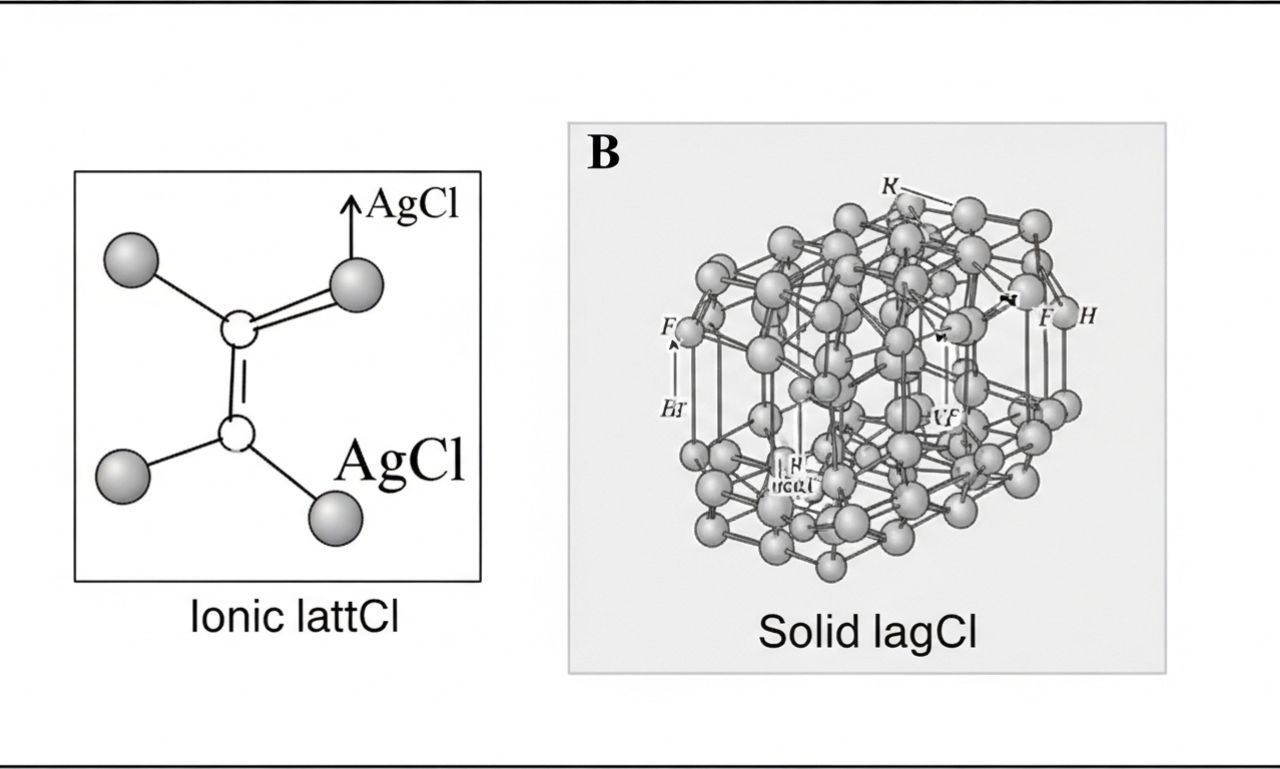
AgCl, or silver chloride, is an inorganic compound widely studied in chemistry due to its unique solubility properties. It is a white crystalline solid that is practically insoluble in water under normal conditions but can dissolve in the presence of certain reagents. Understanding AgCl solubility is important in analytical chemistry, precipitation reactions, and environmental science.
Chemical Properties of AgCl
- Chemical Formula: AgCl
- Molar Mass: 143.32 g/mol
- Appearance: White crystalline solid
- Density: 5.56 g/cm³
- Solubility in Water: Extremely low (~0.89 mg/L at 25°C)
- Melting Point: 455°C (decomposes)
Silver chloride is photosensitive, darkening on exposure to light due to the formation of elemental silver.
Solubility of AgCl
1. Solubility in Water
AgCl is very sparingly soluble in pure water. Its solubility can be expressed using the solubility product constant (Ksp):
Ksp=[Ag+][Cl−]≈1.77×10⁻¹⁰ at 25°CK_{sp} = [Ag^+][Cl^-] approx 1.77 times 10^{-10} , text{at 25°C}
This extremely low Ksp value explains why AgCl precipitates readily when solutions containing silver ions (Ag⁺) and chloride ions (Cl⁻) are mixed.
2. Solubility in Ammonia
AgCl dissolves readily in aqueous ammonia due to the formation of the diammine silver complex:
AgCl(s)+2NH3(aq)→[Ag(NH3)2]++Cl−AgCl (s) + 2 NH_3 (aq) rightarrow [Ag(NH_3)_2]^+ + Cl^-
This property is used in qualitative analysis and silver recovery processes.
3. Solubility in Other Reagents
- Thiosulfate (Na₂S₂O₃): Forms soluble silver-thiosulfate complexes
- Cyanide (CN⁻): Forms soluble complexes like [Ag(CN)₂]⁻
These reactions highlight AgCl’s amphoteric behavior in coordination chemistry.
Factors Affecting AgCl Solubility
- Common Ion Effect
- Presence of Cl⁻ ions decreases AgCl solubility due to Le Chatelier’s principle.
- Temperature
- Slightly increases solubility at higher temperatures, but the change is minimal.
- Complexing Agents
- Compounds like NH₃, thiosulfate, or cyanide increase solubility by forming soluble complexes.
Applications of AgCl Solubility
- Analytical Chemistry: Precipitation reactions to detect chloride ions
- Photography: Light-sensitive AgCl used in photographic films
- Electrochemistry: Used in reference electrodes
- Environmental Chemistry: Studying silver ion mobility and water contamination
Conclusion
The solubility of AgCl is a classic example of how chemical equilibrium, solubility product, and complex formation govern the behavior of sparingly soluble salts. Though almost insoluble in pure water, AgCl can dissolve under specific conditions using ammonia or other complexing agents, making it highly relevant in laboratory applications and industrial processes.
Understanding AgCl solubility is crucial for chemists, environmental scientists, and engineers dealing with silver compounds.