
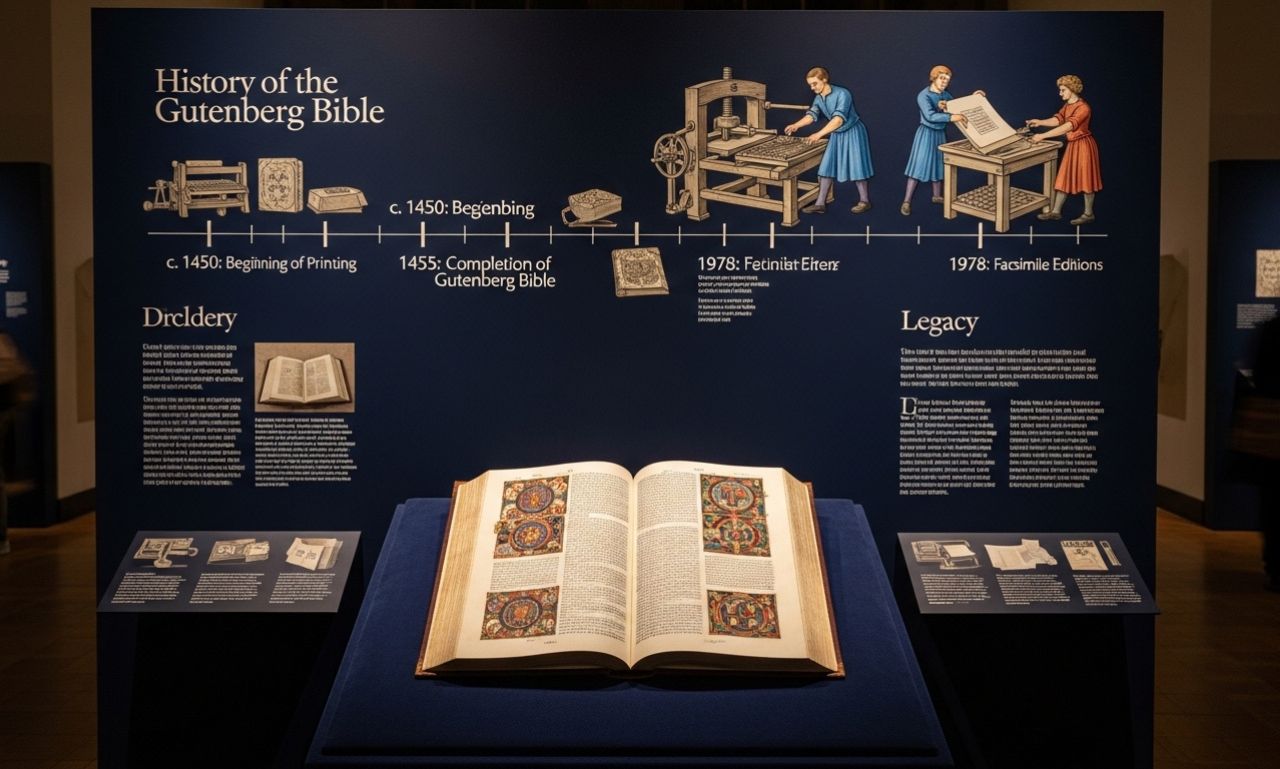
The Gutenberg Bible, also known as the 42-line Bible, is one of the most important books in history because it was the first major book printed using movable type in Europe. Produced by Johannes Gutenberg around 1455 in Mainz, Germany, the Gutenberg Bible revolutionized the way books were made, paving the way for the mass production of texts and the spread of knowledge during the Renaissance.
Historical Background
Before Gutenberg’s invention, books were copied by hand, usually by monks in monasteries, which made them extremely rare and expensive. Gutenberg’s printing press allowed multiple copies to be produced quickly and with consistent quality.
The Gutenberg Bible was printed in Latin, following the Vulgate version of the Bible, which had been widely used in the Catholic Church.
Physical Features
The Gutenberg Bible is notable for its beauty and craftsmanship. Key features include:
-
Two columns of 42 lines per page
-
Large, ornate initial letters that were often hand-illuminated after printing
-
Black ink for the text, sometimes with red ink for headings or emphasis
-
High-quality paper and vellum copies, which have survived for centuries
It is estimated that 180 copies were originally produced, of which about 49 complete copies still exist today.
Significance of Gutenberg’s Printing Press
Johannes Gutenberg’s movable-type printing press had a transformative impact on European society:
-
Increased literacy – More people could access books, which led to greater education and knowledge.
-
Spread of ideas – Scientific, philosophical, and religious ideas could circulate more widely and quickly.
-
Cultural revolution – The ability to mass-produce texts helped fuel the Renaissance and the Protestant Reformation.
The Gutenberg Bible demonstrated that books could be produced efficiently without losing artistic quality, making it a landmark achievement in printing history.
Surviving Copies of Gutenberg Bible
Today, copies of the Gutenberg Bible are considered extremely valuable and rare. They are held in libraries, museums, and private collections around the world, including:
-
Library of Congress, Washington, D.C., USA
-
British Library, London, UK
-
Gutenberg Museum, Mainz, Germany
Each copy is a testament to the early art of printing and remains a symbol of human innovation.
Legacy of Gutenberg Bible
The Gutenberg is more than a religious text; it is a symbol of technological progress and cultural transformation. Gutenberg’s invention of the movable-type printing press laid the foundation for modern publishing and allowed knowledge to reach far more people than ever before.
Its impact continues to influence education, literacy, and communication, making the Gutenberg Bible a cornerstone of both religious and intellectual history.